| Search Art Prints | ||||||||||||||||||||
| Search Artists | ||||||||||||||||||||

|
||||||||||||||||||||
|
|
|||||||||||||||||||



I and the Village
|
I and the Village
Famous Russian-Jewish artist, Marc Chagall, was born in Belarus, but later became a naturalized Frenchman in 1909. The fact that he grew up in a small village would play a prominent role in many of his paintings, including his well-known creation ‘I and the Village’ painted in Paris in 1911.
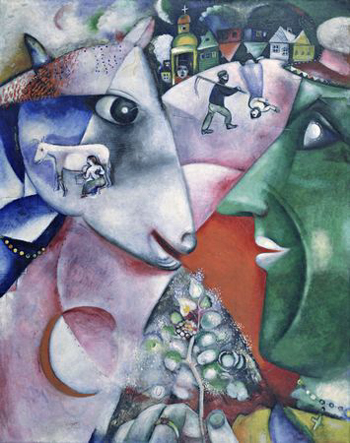
Clearly exhibiting aspects of Cubism, ‘I and the Village’ is a lively composition of various objects, human features and animal components that are fragmented, superimposed, and randomly assembled to produce an abstract arrangement. The colours are vibrant and a stark contrast exists between the red, the green and the blue. It is a painting that provides multiple viewpoints and distinctive perspectives.
Analysis
Influenced by a childhood spent in rural surroundings, Chagall’s ‘I and the Village’ is a dreamlike representation of goats, pastures, a farmer, a violinist, and simplistic images of houses, some of them upside-down. The whole could be viewed as a jigsaw puzzle extracted from a child’s imagination.
The painting possesses a significant amount of intrigue and symbolism. In the foreground of the painting, a green-faced man, wearing a cross around his neck, a cap on his head, and holding a glowing tree, stares directly across at the head of a goat, which encompasses another smaller goat being milked. In the background, a row of houses, an Orthodox church, and a man dressed in black carrying a scythe hurries past an upside down woman playing what appears to be a violin.
The geometric shapes and symbols grab the viewer’s attention. The small and large circles have been said to represent 3 spatial phenomena: the sun’s revolution in orbit, the earth’s revolution around the sun, and the moon’s revolution around the earth. Some have interpreted the smaller circle in the lower left-hand corner as an eclipse.
‘I and the Village’ illustrates the give and take between beings and the vibrant natural world surrounding them. It is a powerful display of the mutual relationship between humans, animals and plants.
“I and the Village” by Marc Chagall is housed in the Museum of Modern Art in New York City, USA.